From Macron to Trump to Israel: What is Syria’s share?
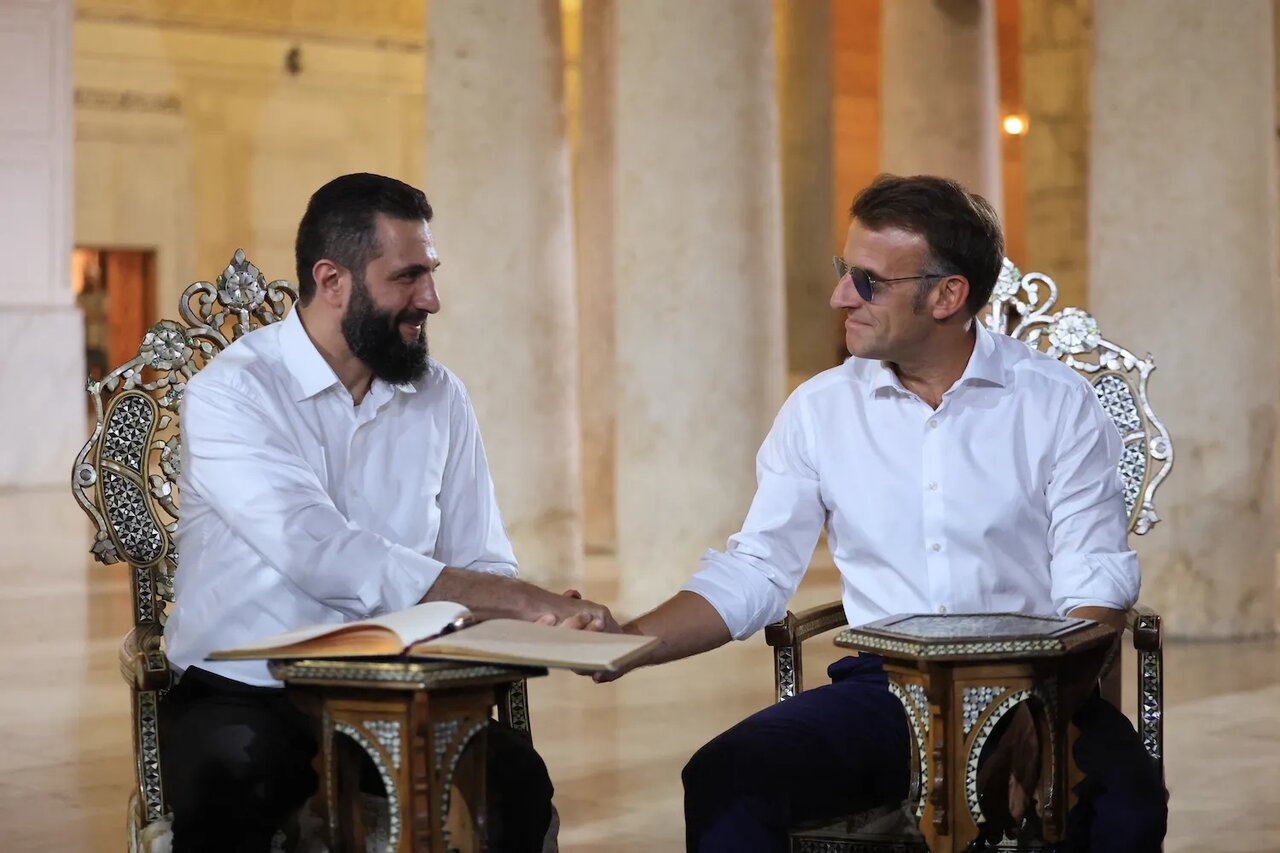
TEHRAN – French President Macron surprised everyone by visiting Syria as the first Western leader to meet self-declared president Ahmad al-Sharaa in Damascus.
One day before the NATO summit in Ankara, Macron’s visit represented a step toward legitimizing al-Sharaa in the international community. Still, Paris’s primary interest lies in stabilizing the regime and strengthening French business interests.
Macron has not hidden his desire to turn Syria into a regional logistics hub serving as an alternative to the Strait of Hormuz.
The state visit was said to have been coordinated with Trump, whose envoy Tom Barrack brought together Syrian Foreign Minister Asaad al-Shaibani and Israeli Strategic Affairs Minister Ron Dermer in Paris in August 2025. This was after French generals helped transport Kurdish-led Syrian Democratic Forces leader Mazloum Abdi from Qamishli to Damascus aboard a U.S. helicopter carrying American generals who facilitated Abdi’s meeting with al-Sharaa.
For historical reasons, Macron’s visit carries fundamental importance for Russia: between 2012 and 2014, the war on Syria was a major cause of tension in Russian-French relations, and although the Ukrainian crisis has supplanted it since 2022, Syria remains perhaps the second most important regional issue affecting Moscow-Paris ties.
France’s role has so far not clashed with British interests. The close relationship between British National Security Adviser Jonathan Powell and al-Sharaa is worth recalling, after former U.S. Ambassador Robert Ford revealed Powell’s role in “educating and rehabilitating Abu Mohammed al-Jolani” to transform into Ahmad al-Sharaa, all at Powell’s request.
The NATO summit saw a cordial meeting between Macron and his counterparts, following Macron’s statement that he and al-Sharaa discussed extending gas pipelines from the Persian Gulf through Syria, a project rejected by the former government in 2008.
Given Syria’s complex circumstances, the dominant powers are mainly the United States, the Zionist regime, and Turkey. Both Russia and France retain influence, but within a limited scope, neither side is likely to possess sufficient resources to compete with other parties.
Trump has frequently claimed credit for bringing al-Sharaa to power, sometimes asserting he did so single-handedly, other times acknowledging the role of others, presumably Netanyahu.
The U.S. President reiterated his support for al-Sharaa during the NATO summit in Ankara, praising him in a separate meeting on the margins of the gathering. Reports indicated tension during these meetings.
There have been no statements on whether or how they agreed or disagreed on U.S. demands from al-Sharaa, whom Trump envisions playing a key role in broader American projects concerning Lebanon, Iraq, and Iran, which he threatened as usual both before and during the summit.
It was evident from al-Sharaa’s strained expression during his bilateral meeting with Trump that he was under intense pressure aimed at securing the largest share of the Syrian pie for the United States.
Turkey’s vast influence across all sectors of Syria is difficult to brush aside. Ankara had built exceptionally broad ties with militant factions since 2011, with the northwestern province of Idlib later relying on its neighbor for all its needs.
However, the most troublesome hammer hanging over al-Sharaa is Trump’s, who periodically asserts that he brought al-Sharaa to power and granted him international legitimacy through their meeting in Riyadh on May 14, 2025, followed by an invitation to the UN General Assembly and hosting him at the White House on November 10.
Trump’s primary agenda is for al-Sharaa to help realize his ambitions launched through the “Abraham Accords”, aiming to resolve their fate before his term ends. By removing Syria from the U.S. list of state sponsors of terrorism while conveniently forgetting that he had previously designated Abu Mohammed al-Jolani as among the world’s most dangerous terrorists.
Far more alarming than the diplomatic maneuvering is the accelerating Zionist military campaign across southern Syria, a development that has fundamentally altered the security landscape since the fall of the former government in December 2024.
Israeli Occupation Forces (IOF) have not only conducted occasional cross-border raids; they have established a persistent and expanding military footprint inside Syrian territory, carrying out regular invasions.
In recent days alone, the IOF launched multiple coordinated invasions across the provinces of Quneitra and, more alarmingly in Daraa. An IOF unit comprising a tank and two military vehicles advanced into western rural Daraa for the first time, opening fire before withdrawing toward occupied Syrian territories.
Local sources in Daraa also reported that three armored vehicles reached the main road between Saysoon and Jamlah in the Yarmouk Basin, where IOF soldiers set up a military checkpoint, stopping vehicles, conducting searches of passersby, and checking their identification.
In a separate operation, an IOF unit of more than 15 vehicles pushed into the village of Al-Ayshah in southern Quneitra, searching houses and a feed storage facility.
What distinguishes this aggression from previous IOF invasions is not just their frequency but their brazenness. Verified video footage that has surfaced showing IOF troops assaulting Syrian women in Daraa itself. These scenes have long been associated with the occupied West Bank and al-Quds (Jerusalem), but are now emerging from Syrian soil for the first time.
Such images were unheard of during the former government, whose security apparatus maintained a firm grip on the southern provinces and prevented the IOF from operating with such impunity in the buffer zone, let alone within Syrian towns and villages.
The footage highlights with alarming clarity how easily the IOF can now penetrate deep into southern Syria without encountering any government-backed resistance. This is a direct consequence of the new administration’s inability or unwillingness to confront Israeli aggression.
The regime has openly declared the 1974 Disengagement Agreement null and seized control of the Syrian buffer zone.
There is growing fear that these invasions are not temporary but part of a deliberate campaign to consolidate Israeli occupation in southern Syria, gradually expanding its foothold and establishing permanent military positions that could reshape the region’s strategic balance.
The new Syrian leadership, for its part, has remained conspicuously silent in the face of this escalating aggression. Despite al-Sharaa’s close ties to Trump and his reliance on American endorsement for international legitimacy, there has been no meaningful action to resist the IOF or secure a withdrawal from the occupied Syrian territories.
This inaction raises serious questions about whether al-Sharaa, who owes his position in large part to Trump’s backing, is willing or able to challenge the regime while depending on U.S. support to maintain his hold on power. The same power that the rulers in Damascus have used to crush minority groups in Syria.
Leave a Comment